
 Randy Joe Sa'ah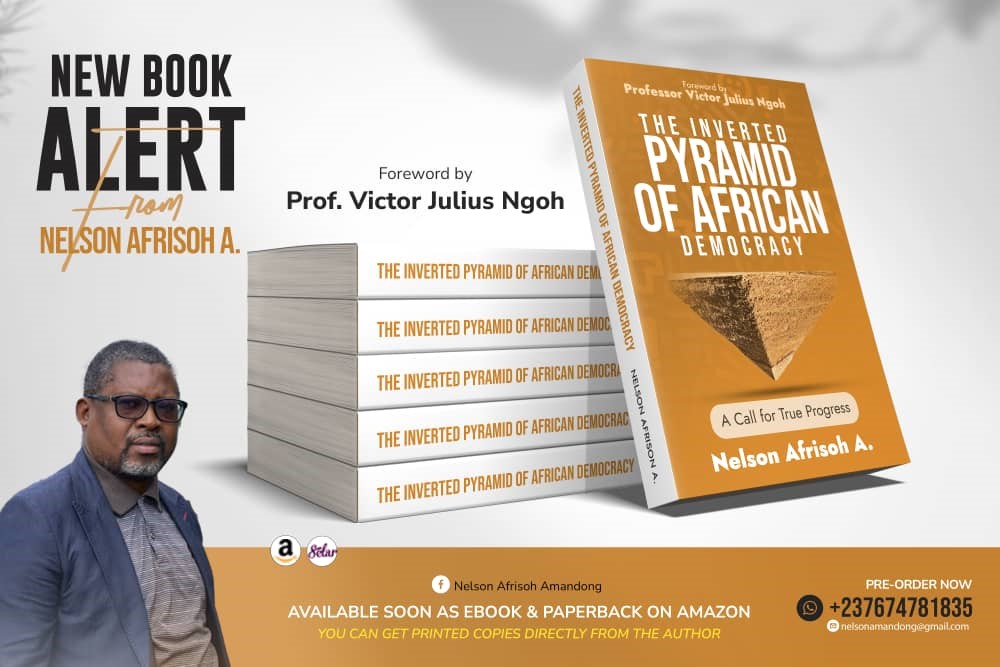
New Book Explores
Story, Randy Joe Sa’ah
As Cameroon braces for the crucial October 2025 presidential polls, a profound new narrative emerges to challenge the very foundations of African governance. Nelson Amandong’s “The Inverted Pyramid of African Democracy” is a fresh political critique. It is also a mirror held up to a continent where those in power often exist in a world starkly removed from the daily struggles of the people they claim to serve. The book’s central metaphor — an “inverted pyramid” — powerfully encapsulates a system turned on its head, where decisions flow from a detached elite at the top, leaving the masses at the bottom burdened by pervasive poverty, insecurity, and a gnawing loss of hope.
Cont’d on page 3
Cont’d from page 1
In Cameroon, this writing resonates with particular urgency. With incumbent President Paul Biya, who has remarkably clocked 42 straight years in power, poised to seek yet another seven-year term, the book’s timing is both opportune and absolutely critical. It forces society to confront whether the upcoming elections, under such entrenched leadership, can truly address the deep-seated issues plaguing ordinary Cameroonians, or if they will merely perpetuate a system where the “voices at the bottom” remain unheard. Amandong’s work presents a timely and indispensable framework for understanding the profound disconnect between governance and the fundamental human needs that truly empower a populace.
Amandong’s genius lies in drawing on Abraham Maslow’s Hierarchy of Needs, a psychological theory traditionally applied to individual well-being, to diagnose Africa’s democratic malaise. He posits a simple, yet revolutionary truth: before citizens can fully engage in shaping their future, their most basic needs for food, safety, respect, and opportunity must first be met. When these foundational layers are ignored, replaced instead by abstract political rhetoric or the mere performance of periodic elections, democracy becomes a hollow shell, an “inverted pyramid” benefiting only a tiny elite while marginalizing the vast majority. This leads to institutional collapse, systemic disparities, and the erosion of democratic principles that should, in theory, guarantee fairness and shared progress.
The book delves into the pervasive “strongman” rule and the troubling concept of the “Father of the Nation” that stifles genuine democratic participation across the continent. Such authoritarian tendencies, as Amandong vividly illustrates with examples from various African countries, are the inevitable outcome when the “inverted pyramid” is the prevailing order. Democracy, he argues, is far more than just holding elections; it encompasses how those elections are organized, conducted, and how results are proclaimed, ensuring a level playing field for all stakeholders. Where these conditions are absent, what remains is a facade, not a true government “of the people, by the people, for the people.”
For Cameroon, this analysis is particularly moving. The nation, despite its rich natural and human resources, finds itself, like many African countries, among the least developed. The upcoming 2025 presidential election represents a critical juncture. Will it be another exercise that reinforces the “inverted pyramid,” or will it be a catalyst for a fundamental shift towards addressing the core “needs” of the populace? Amandong’s powerful assertion, echoing R. Miller, that “true progress is built on the simplest of foundations: food on the table, a roof overhead, and a sense of safety in one’s surroundings,” serves as a potent reminder for leadership. Africa’s journey toward a verifiable democratic society, the book forcefully argues, cannot be confined to mere political reforms; it must fundamentally address these underlying human necessities.
“The Inverted Pyramid of African Democracy” is a clarion call to action. It offers a searing critique as well as a roadmap for hope, showing that lasting change begins with leadership that truly listens and acts with care and humility.
The book will be launched in Limbe come July 4th and later in Buea. For those who have been privileged to have a foretaste of the book, it is an indispensable companion for every citizen, policy-maker, scholar, and student. As one observer put it, “It’s a bold challenge for Africans to “bell the cat” and embark on the arduous but essential task of rebuilding governance from the ground up, fostering a future where power serves fairness, dignity, and shared progress for all. The time to re-orient the pyramid, and genuinely empower the people, is now.”