 Randy Joe Sa'ah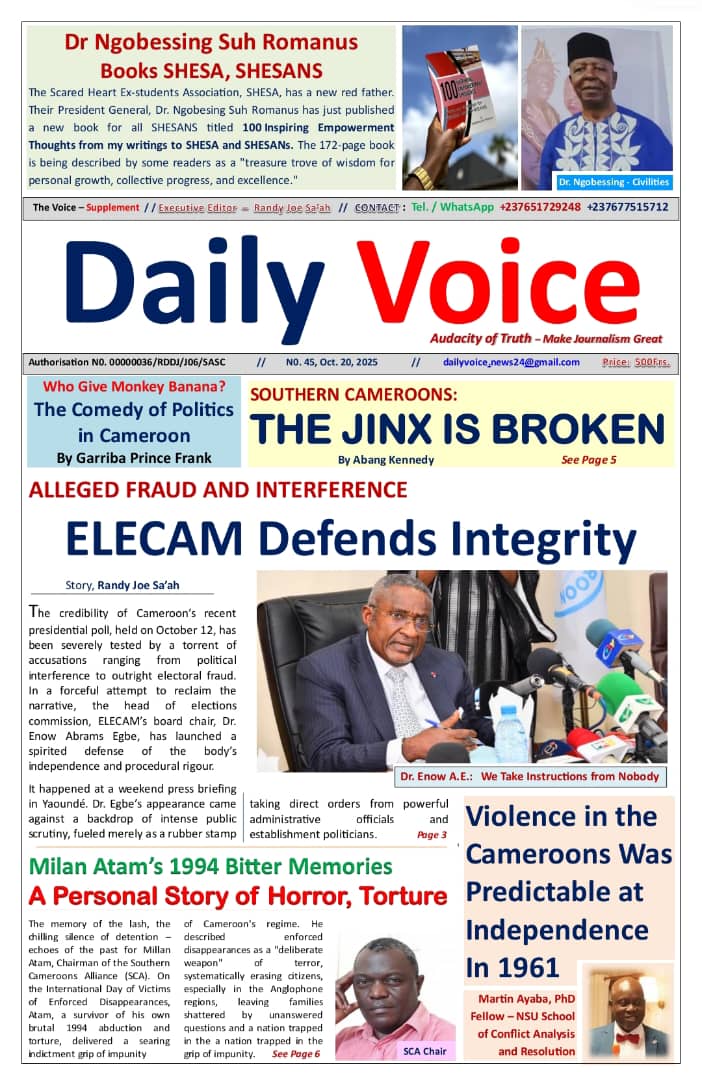
Martin Ayaba, PhD Fellow – NSU School of Conflict Analysis and Resolution
The arrest and indictment of two supposed nationals of the Cameroons in Minnesota on September 5, 2025, by the US Justice Department on charges of financing and directing violence in Cameroon , as reported by Yahoo News, and many others, does not tell the entire story of their arrest. In Norway, Dr. Cho Ayaba, the leader of the independence movement of Ambazonia, which is the name of the former Southern Cameroons, was arrested because he allegedly used social media to advocate for the independence of the Southern Cameroons. I can add to this list: District of Maryland: Two Conspirators Sentenced to almost four years in Federal prison for illegally exporting firearms, ammunition, and military-style items to Nigeria to assist separatists fighting against the government of Cameroon. Another case in point is the 2018 arrest and deportation to Cameroon of many separatist leaders in Nigeria for holding meetings. These leaders have since been walloping in prison in the capital of Cameroon after a military tribunal sentenced them to life imprisonment on charges of attempting to secede from Cameroon.
The context of these arrests, imprisonment, and deaths must be seen from the broader perspective of the conflict that has pitted the Cameroon government against the over 6 million people from the English part of Cameroon.
This conflict was predictable at independence in the 1960s, when the former British Southern Cameroons, which makes up 20% of the population, and the majority French Republic of Cameroon, were sneakily forced together in a patchwork of very different backgrounds and cultures without guaranteeing that their personal identities inherited from long years of the French and British colonial heritages would enable a peaceful cohabitation.
The current phase of the conflict started as a peaceful protest in 2016, when teachers, students, and lawyers took to the streets of the English part of the country to protest the use of the French language in English classrooms and the use of French judges from the civil law jurisdiction to sit in the common law courts of the English system. These protests led to a violent crackdown by government forces, ordered by President Paul Biya, who, at 92 years of age, has been in power for 43 years. The crackdown provoked militant groups from the English part of the country to pick up arms to fight back.
The International Crisis Group (ICG) has reported that over 6500 people have been killed since this current phase of the conflict. The ICG also indicates that over half a million people have been internally displaced, while 250000 children are not able to go to school. Neighboring Nigeria is currently hosting 77000 people as refugees from the English part of Cameroon. The Cameroon military has burnt over a thousand towns and villages in the English part of the country
As to the remote causes of the conflict since 1960, people from the Southern Cameroons nurse many grievances towards French Cameroon’s exploitation and usurpation of their economic and political institutions of pride. For example, a thriving company called ‘The National Produce Marketing Board ‘ that used to help thousands of farmers across the territory sell their cocoa and coffee produce internationally, was forced to move its business to Douala in the French part of the country, and its assets were mismanaged and dilapidated through the influence of the French central government. Also, the biggest bank in the Southern Cameroons that used to offer financing to businesses in that part of the country was forced to transfer to the French part of the country, and its assets were literally stolen through the instigation of the central government in Yaounde.
Elsewhere, an international airport in the town of Tiko, in the English part of the country, and a deep-water seaport in the coastal town of Victoria that offered thousands of jobs to the local population were deliberately closed down by the government in French Cameroon to force all local businesses to go across to the French side of the country to do business. When petroleum was discovered in the Bakassi Peninsula in the English part of the country, the population of Victoria, where an oil refinery was constructed, was stunned that 95% of the workers in the facility were ferried in from the French part of the country to come and work there, while the taxes of the company were paid in Douala in French Cameroon.
Leading up to independence in the mid-1950s, Southern Cameroon had a fully functioning parliament with multi-party debates and a Prime Minister in charge of government activity. Between 1955 and 1961, there were three democratically held general elections in the Southern Cameroons, which led to the first peaceful transfer of power in Africa from the sitting Prime Minister EML Endeley to the leader of the opposition, who won the election, John Ngu Foncha. This dynamic was different in the majority of French Cameroon, which has known two presidents since 1960, when the country gained independence from France. Amadou Ahidjo, who ruled from 1960 to 1982, and Paul Biya, who was given power in 1982 and is still president today.
From a legal and factual standpoint, the people of the Southern Cameroons still don’t understand why they should be ruled by French Cameroon from their capital in Yaounde when they have never shared a common destiny with French Cameroon.
French Cameroon gained independence on January 1, 1960, from France with its distinct borders, while the Southern Cameroons were still under British rule. On April 21, 1961, the UNGA voted by 64 votes in favor and 10 abstentions for granting independence to the people of the Southern Cameroons. On the 1st of October 1961, this vote was thwarted when the sovereignty of the people of the Southern Cameroons was handed over to the French Cameroons. Nowhere in the United Nations archives or on today’s CHATGPT can anyone find a single agreement or contract that shows how these two former UN territories came to be together as one country.
The government of Cameroon has torpedoed all efforts to resolve the root causes of this conflict. Before he left the UN, Kofi Annan, visited Cameroon and handed out the two flags representing the two territories to Paul Biya. In September of 2022, the Cameroon government rejected the Swiss government’s mediation initiative to resolve the conflict. On the behest of the Cameroon government, the foreign minister of Canada, Majorie Jolly, initiated a process of facilitation that involved the Cameroon Government, the various Armed groups, and the United Nations, but once again, the regime in Yaounde walked out of the meetings in Ottawa, Canada.
That is the cause of this conflict and violence.
The international community must not only pay attention to the conflicts in Ukraine and in Palestine. The UNO, Great Britain, France, and other members of the international community must hold the Cameroon Republic to respect its obligations by respecting the rights and freedoms of the people of the Southern Cameroons.
Martin Ayaba, LLB.MPA
PhD Fellow – NOVA, Southeastern University, Fort Lauderdale. Fl